Rhetoric

There is nothing in the world like a persuasive speech to fuddle the mental apparatus and upset the convictions and debauch the emotions of an audience not practiced in the tricks and delusions of oratory.” – Brother Mark Twain, The Man That Corrupted Hadleyburg and Other Short Works

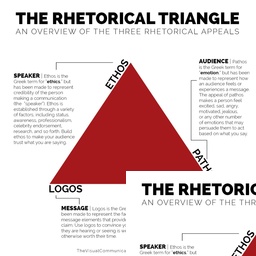
Rhetoric is the art of persuasion; or the “application of language in order to instruct…” (Wikipedia, 2020)  It is one of the three arts of discourse (the other two being grammar and logic).  These three items combined form what is referred to as “the trivium.”  Rhetoric can, invariably be broken into three appeals:

Ethos – “ethos” is the Greek term for ethics.  In this context however, it is used to represent the credibility of the speaker.  The goal for the speaker is to establish ethos; that the listener(s) can trust what is being said.  This can be done in a variety of ways including the speaker’s status, awareness, professionalism, celebrity, research, etc.  In other words, we trust what this person says because of their experience or exposure to the issue. 

Logos – “logos” is the Greek term for logic but in this context has been made to represent the facts, research, and other components of the message or speech which provide support, proof, or evidence that what is being said is true.

Pathos – “pathos” is the Greek term for emotion but in this context has been made to represent how the audience feels or experiences a message.  Pathos has as much to do with what one is saying, as how it is being said.  This is typically the component of rhetoric which calls a listener to action.

Music & Masonry

Music, for many, is an outlet.  It helps to start the day, unwind from a long one, or simply helps makes it go by faster.  Whether you play an instrument, sing, or just like to turn it up and listen, music has the ability to change the way people think and feel.  From a Masonic perspective, music used to play a much more substantial role in all of our activities.  During the enlightenment (and for some great time thereafter) Brothers would write custom songs for meetings, degrees, dinners, and other Lodge activities.  This was done simply to make the activity that much more special.  It manifests in everything from lyrics, rhythms, album artwork, and more.  Interestingly, some very recognizable songs have Masonic references, roots Freemasonry or Masonic symbolism, or were written by a Brother.  Here are some examples of those well-known songs:

Auld Lang Syne,” Bro. Robert Burns – This song, now commonly heard at the stoke of midnight on New Years Eve, was actually a poem.  While there are many interpretations as to his intended message, it is pretty clear this song is about making friends/connections among strangers, celebrating life, and cheerfully mourning those friends who have passed.

The Magic Flute,” Bro. Wolfgang Amadeus Mozart – This is a special one and it isn’t a single song; rather, it is an entire opera.  Unlike several of these examples, too, it makes no direct reference to Freemasonry, being a Mason, or anything of the sort.  Rather, the link to Masonry exists in the score itself.  HINT: it’s more than just the continuous repetition of the number three.

Call Me Up Some Rainy Afternoon,” Bro. Irving Berlin – Written in 1910, the same year Bro. Berlin was initiated, this song actually makes direct reference to “Be[ing] a Mason,” and keeping a conversation between two prospective lovers in confidence.

Jump Around,” House of Pain – This is a really odd one, mainly because it can be interpreted in a few different ways.  The authors, not known to be Masons, included two phrases in the song, “ Do you know about the Masons, about their nation?” and, “ To the 33rd degree, you know that’s me.” In context, they could either be references to the ridiculous conspiracy theories dogging our craft, or, it could be a reference to our craft’s ideals of a peaceful and harmonious world.

If

If you can keep your head when all about you
Are losing theirs and blaming it on you,

If you can trust yourself when all men doubt you,
But make allowance for their doubting too;

If you can wait and not be tired by waiting,
Or being lied about, don’t deal in lies,

Or being hated, don’t give way to hating,
And yet don’t look too good, nor talk too wise:

If you can dream—and not make dreams your master;
If you can think—and not make thoughts your aim;
If you can meet with Triumph and Disaster
And treat those two impostors just the same;

If you can bear to hear the truth you’ve spoken
Twisted by knaves to make a trap for fools,
Or watch the things you gave your life to, broken,
And stoop and build ’em up with worn-out tools:

If you can make one heap of all your winnings
And risk it on one turn of pitch-and-toss,
And lose, and start again at your beginnings
And never breathe a word about your loss;

If you can force your heart and nerve and sinew
To serve your turn long after they are gone,
And so hold on when there is nothing in you
Except the Will which says to them: ‘Hold on!’

If you can talk with crowds and keep your virtue,
Or walk with Kings—nor lose the common touch,
If neither foes nor loving friends can hurt you,
If all men count with you, but none too much;

If you can fill the unforgiving minute
With sixty seconds’ worth of distance run,
Yours is the Earth and everything that’s in it,
And—which is more—you’ll be a Man, my son

Bro.. Rudyard Kipling

Grammar

Grammar is the skill of knowing language.  Grammar is the “who, what, when, where, and how” of understanding and knowledge.  It is how we combine the elements of language; subject and verb tense, punctuation, spelling, and other linguistic mechanics.  Grammar lays the groundwork for effective communication.  It is for this reason that libraries are full of texts expounding the importance of the study of this science.  These texts even use clever titles to illustrate the importance to the subject, such as, “Eats, Shoots & Leaves,” by Lynne Truss, which features panda bears arranging punctuation marks.  The alternative, without the comma, results in a completely different interpretation – eats shoots and leaves – which explains the presence of the pandas. But, why is it important for Freemasons to study this?

Our eminent Brother Albert Mackey said, “God created man the participant of reason and as he willed him to be a social being he bestowed upon him the gift of language in the perfecting of which there are three aids: the first is Grammar, which rejects from language all solecisms and barbarous expressions; the second is Logic, which is occupied with the truthfulness of language; and the third is Rhetoric, which seeks only the adornment of language.”  Simply put, Masons are prompted to study grammar because it helps us to express our thoughts and feelings more effectively, thus making ourselves better men.

“In order to communicate his own interpretation of the symbolism of any topic of organized learning, as well as what he learns from the natural world around him, the study of grammar, regardless of the age of the individual, is pivotal” (The Masonic Philosophical Society, 2017).  Grammar therefor, as a tool, is intended to assist us in conveying ideas and bringing consensus, not division.  To teach and to understand differences, an enlightened person concerns himself with the study of communication.  This, fundamentally, is the study of the grammar of language.

Platonic Solids & Sacred Geometry

In his 360 B.C. dialog, Timaeus, Plato wrote about the concept of what is now referred to as Platonic Solids (later named for Plato).  These were likely discovered well before Plato, despite his getting all of the credit.  Also known as regular solids, or regular polyhedra, they are convex polyhedra with equivalent faces composed of congruent convex regular polygons.  There are exactly five: the cube, dodecahedron, icosahedron, octahedron, and tetrahedron.  Some of the more geeky Brethren would probably recognize many of these shapes in dice commonly used in role-playing board games, like Dungeons and Dragons, or puzzles, like the Rubik’s Cube (which comes in each of these shapes, consequently).

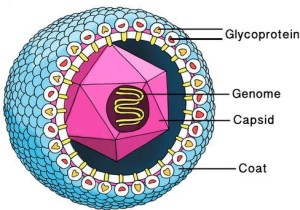
The shapes are important, not only for helping decide the fate of one’s High Elf Fighter but, were anciently believed to have had a fundamental role in the cosmos.  In 1596, Johannes Kepler published the book, Mysterium Cosmographicum, in which he theorized that positions of the known planets and their respective orbits corresponded to the Platonic Solids inscribed within one another (see image 1).  That theory has been disproven, but the shapes still fascinate mathematicians, philosophers, and architects alike.  Interestingly, the further scholars have gotten from theories about these shapes, the more often they saw them.  For example, the tetrahedron, cube, and octahedron, all occur naturally in crystal structures.  Certain chemical compounds include discrete icosahedra within their crystal structures.  Many viruses have the shape of regular icosahedron and it has been discovered that this special shape allows the virus replicate more easily and save space in its genome (see image 2).  Even in modern meteorology and climatology, global numerical models now increasingly employ geodesic grids based on an icosahedron, rather than the more commonly used longitude/latitude grid, because of the increased resolution these models provide.


1
Image 1: Platonic Solid model of solar system

2
Image 2: Viral cell with icosahedral capsid

The Beehive

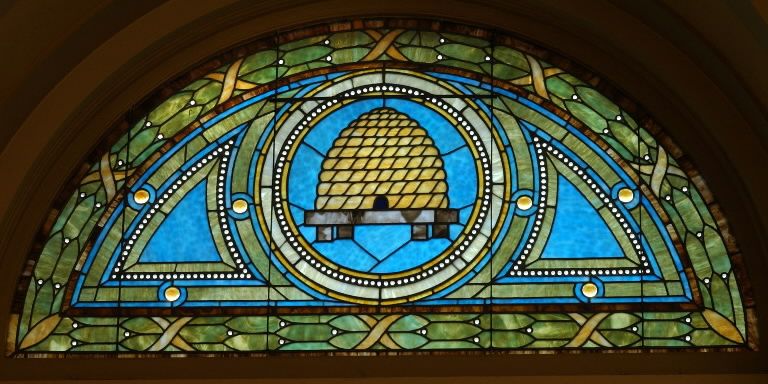
The Beehive is an ancient symbol used by Romans, Egyptians, Greeks, and countless other civilizations and organizations since early human history.  It has been used by our fraternity from time immemorial but has progressively fallen out of use since “the Union,” in 1813, which created the United Grand Lodge of England.  In a Masonic context, it is typically depicted in its early form: a conical-shaped structure placed on a stand or box, with seven bees flying around it.  Seven bees, because that is the number of Brothers required to open a “perfect” lodge of Entered Apprentice Masons.

The Beehive serves to remind us that, “… we are born into the world [as] rational and intelligent beings, so ought we also be industrious ones, and not stand idly by or gaze with listless indifference on even the meanest of our fellow creatures in a state of distress if it is in our power to help them without detriment to ourselves or our connections…” (according to the ritual of Royal Cumberland Lodge; 18th century).  It is symbolic of industry, order, and duty – to ourselves, our Brothers, the Fraternity, and society.  The implication is that if bees are born into this world with inherent knowledge of their responsibility to contribute to the collective good, there is an expectation that we would recognize a similar responsibility to our own “hive,” or our lodge.

Maewyn Succat

Each year since the early 17th century, millions of people in Ireland and beyond take a day to remember Maewyn Succat, foremost patron saint of Ireland, otherwise known as “Saint Patrick.”  According to record (such as it is), Succat, born in Britain sometime during the middle-fifth century, was captured in his early youth and taken to Ireland where he became a slave.  He converted to Christianity, eventually escaped to mainland Europe, and found refuge at Marmoutier Abbey in France, where he committed himself to the Christian conversion of Irish pagans.   After a long life proselytizing the faith in Ireland, he eventually passed on March 17th, 461 A.D.  Interestingly, he was “venerated” but was never actually “canonized” (made a true “Saint”) by a recognized religion, despite his works being celebrated in the Roman Catholic, Old Catholic, Anglican, Lutheran, and Eastern Orthodox Churches.

Almost 1300 years later, during the French and Indian War, a young Colonel took note of the low morale among his predominantly Irish troops and decided to give them some much-needed rest.  Given so many of his troops were Irish, he declared March 17th a general holiday.  Nearly twenty years later, this Colonel, now a General in the Continental Army, observed the same condition among his men and made a similar declaration – it was their first day off in over two years.

Perhaps the Irish diaspora can thank St. Patrick for their salvation, but we can thank our Brother, General George Washington, for providing Americans the opportunity to enjoy green beer!

Brotherly Love

“By the exercise of Brotherly Love, we are taught to regard the whole human race as one family – the high, the low, the rich, the poor – who, as created by one Almighty Parent, and inhabiting the same planet, should aid, support, and protect one another. On this principle, Masonry unites men of every country, sect, and opinion, and promotes true friendship among those who might otherwise have remained at a perpetual distance.”

This is what we all hear in lodge and what we are encouraged to practice.  So, we embrace our Brothers in lodge, after meals, and as we hastily make our way into or out of meetings.  Some may loan or giveaway clothes, tools, furniture, money, or simply our talent, to those in need.  The best of us reach out to our friends when we haven’t heard from them in a while, seen them in lodge, or some we will even stop by the Brother’s house to see how they are.  However small, these are all good examples of the tenet being put into action within our Fraternity.

However, they are… We are… I am… Guilty of focusing too much on what this means among Brothers.  We allow culture, country, sect, opinion, and any one of a dozen other factors, to distract us from what I am coming to see as the more important part of the statement: “to regard the whole human race as one family.”  We could all stand to remember that when our life and choices are measured, it will be our acts of kindness toward those we don’t know which will carry the most weight.

Anno Lucis

Anno Lucis

As we have just begun a new year, it seems appropriate to call attention to a special system of dating, used by Masons for hundreds of years.  If one spends enough time seeking further light in Masonry, they invariably see articles, procedures, and certainly cornerstones, which refer to “Anno Lucis” or “A.L.”  What does it mean? Where does it come from? To understand it, let us start with some basics:

B.C. – “Before Christ,” previously, “a.C.n.,” or “Ante Christum Natum,” meaning before the birth of Christ.”  There is no consensus as to when the shift to B.C. occurred.  Other, non-secular versions are also used, such as B.C.E. and C.E., which are translated “Before the Common Era,” “Common Era,” or “Current Era.”  Regardless of phrasing, all of these notations refer to the same era and the Gregorian and Julian calendars.

AD (anno Domini) – Medieval Latin, meaning “In the Year of the Lord.” This was abbreviated at some point from the original “anno Domini nostri Jesu Christi.”  The term Vulgaris Aerae, or “Vulgar Era” is also used to describe the same period after the supposed birth of Christ.  This calendar began with year 1, in the transition from the use of B.C. to A.D., there was no year 0.

AM – (anno Mundi) – Medieval Latin, meaning “in the year of the world.” This calendar system is based, primarily, upon accounts (Old Testament) of the creation of the world and the events which followed.  It is still used within Jewish communities for religious and other purposes.  This era is calculated to have begun on October 7, 3761 B.C. when translated into the Gregorian calendar.  At sunset, on September 9, this calendar began year 5779.

AL (anno Lucis) – Medieval Latin, meaning “in the Year of Light.” This calendar system, invented in the 1700s, was intended to be a simplification of the anno Mundi system.  The system adds 4,000 years to dates in the Gregorian calendar, making the year 2019, 6019.

Okay, now that we have covered that…

Anno Mundi was created in 1658, by Irish Anglican Bishop James Ussher, who believed he had calculated the exact date of God’s creation of the world.  He derived this date by correlating biblical accounts with those in Hebrew genealogy, Middle Eastern history, and other events.  His theory advanced Sunday, October 23, 4004 B.C. (in the Gregorian calendar) as the date the world was created.  The theory became widely accepted and, by 1701, new editions of the King James Bible were being produced, proudly proclaiming that, while not part of scripture, this was the date true Christians should accept.

It should be no surprise, then, that when the United Grand Lodge of England was formed, just sixteen years after Anno Mundi began to be referenced in Bibles, that Masons began using it to date documents using 4004 B.C. as the first year.  However, even in 1717, brethren elected to create a short form and modified the Mundi system to correspond to the Gregorian calendar, making 1717, 5717, and thus Anno Lucis was born.

Reblog: Freemasonry in the Age of Woke

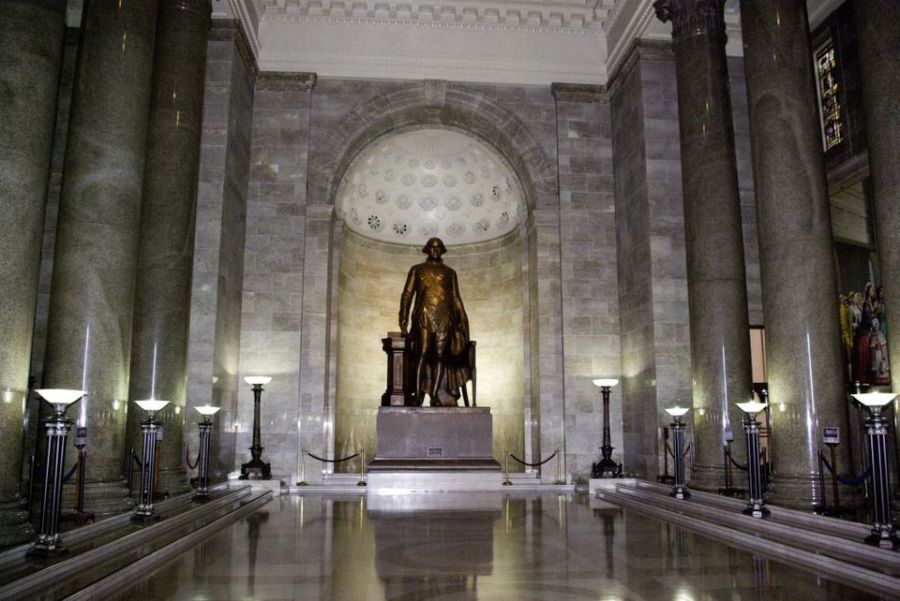
There’s a disappointingly superficial piece on the Washington Post website today by feature writer Sadie Dingfelder about the George Washington National Masonic Memorial in Alexandria, Virginia. As I read it, I was immediately struck by a picture it paints of a growing number of Americans these days and how Freemasonry is seen by them.

Here are some excerpts from Dingfelder’s article, ‘Unlock the secrets of the Freemasons – or at least gawk at their strange costumes:

“Is it usually pretty quiet here?” I asked the person checking me in, who later turned out to be my tour guide.

“It can get pretty busy in the summer,” he replied. In warm months, busloads of Masons visit the memorial, he said.

“I must admit, I don’t know much about Freemasons,” I said, which prompted my guide to launch into a short history of the group.

“It’s basically a fraternal organization,” he concluded. “They do a lot of service and charity work.”

“Oh, so it’s like the Rotary Club, but with costumes and secret handshakes,” I said…

[snip]

The memorial also houses a museum of Masonic history, and we’d just arrived on a floor devoted to that when a muffled voice emanated from my guide’s walkie-talkie. He rushed off to fetch a late-arriving tourist, leaving me alone in a room full of creepy mannequins attired in the costumes of various Freemason subgroups and affiliated societies, including Shriners’ fezzes, Arabic-looking turbans, militaristic uniforms and one costume with a jeweled breastplate, an imitation of vestments worn by ancient Israelite priests.

I found this to be a fascinating glimpse into a less-woke era, but I was disappointed that I couldn’t find any explanatory text about why these groups of (I imagine) white men wore Middle Eastern-ish garb, and whether similar costumes are still used today.

Some of the Freemason costumes on display struck this reviewer as Orientalist,
militaristic or just plain strange.

Scattered around the mannequins were displays of random club ephemera — plus a few inexplicable objects, including a jaunty bobblehead doll of the controversial Christian figure Jacques de Molay, a monk who fought in the Crusades and was later sentenced to death. De Molay’s medieval order, the Knights Templar, inspired the modern-day Knights Templar — a Christian-focused subgroup of Freemasons, my guide explained after returning with a mysterious man in a trench coat…

[snip]

If I’m right, he’s an increasingly rare breed. Freemason membership has been in decline since the 1960s, according to a chart on display in the museum’s basement. “Civic life declined as people spent more time alone in front of a television or computer screen,” the accompanying text explains. Fair enough, but I’m betting that the Masons’ fraught racial history and continued exclusion of women have also contributed to their diminishing relevance.

I mention this because the Masonic memorial may be on its way to becoming just that: a memorial to a bygone organization, where powerful men once gathered to socialize, plan charitable work and wear Orientalist costumes. Perhaps a lot of this is best left in the past, but it seems to me — a person who spends way too much time alone, in front of a computer — that there’s something here worth bringing into the future.

The benefit of resources like LinkedIn is that you can go and find out about the background of people whom you otherwise don’t know at all, and Sadie’s profile yields a few items worth noting. She’s not a teenager or a college student — she graduated in 2001, so she’s in her mid- or even late-30s. Sadie’s a graduate of Smith College (a private liberal arts college for women only in their undergrad program), and she’s been working as a writer for the Post in the Washington D.C. area in various capacities for ten years. She lives and works in the very city that a lot of Masons (and even non-Masons) regard as one heavily influenced by Freemasons from the past, and (if you believe in such things) filled with Masonic symbolism even in the street map. TV producers of programs about Freemasonry are obsessed with the idea. So it surprised me a bit to see just how little knowledge or awareness of Freemasonry she seemed to have when she walked into the Memorial — and apparently, how little she had actually learned by the time she left. After touring the place, she declared that Freemasonry is little more than a bygone organization.

This isn’t a hit on Ms. Dingfelder, not at all. It’s a comment on how diminished we have become in the collective American psyche. I thought we had reached rock bottom in that regard back before novelist Dan Brown put Freemasonry back on the map in the early 2000s. Since those dark days, cable television has had loads of programs about Masonry. Stacks of factual, intelligent, and truthful books (including mine and Brent Morris’) got poured onto the market. Freemasonry worked its way into pop culture references like movies, music and TV shows. I had thought we had even turned a tiny corner and tipped the scales slightly back into our favor, at least as far as a basic awareness of Freemasonry was concerned.

Indeed, the Scottish Rite NMJ did a survey two years ago and discovered that a full 81% of respondents had at least heard of Freemasonry, even if they didn’t know what it was. But as I think back over the last five or six years now, and reflect on my own contacts with the public about it, I fear more people are even less aware of what Freemasonry actually is than in the 1990s. In that same survey, less than 30% actually knew what the values of Freemasonry were. And the most common question I get asked by non-Masons under 35 these days once I get my basic elevator speech out of the way is, “But just what is it that you guys DO? What’s the point?”

That shouldn’t be a shock, since we are about one generation removed from the 1990s. The adults in 1990 were having children at that moment in time, and we are now encountering those former infants as adults today. Already by 1990, Freemasonry had been waning, along with a raft of other social changes taking place then. By 1990, the fraternity was already down in membership by more than 30% from its 1958 height. It was blatant that the Baby Boomers had steered clear of Freemasonry, just as they had so many other so-called “Establishment” ideals of their parents. Organized religious attendance was decreasing. Divorce rates had skyrocketed. Childbirths were down substantially, and most concerning, single parent households (usually single moms) were taking a major upswing. It was into this period that today’s current Millennial adults now in their late-20s and 30s were born.
FT_Family_Changes

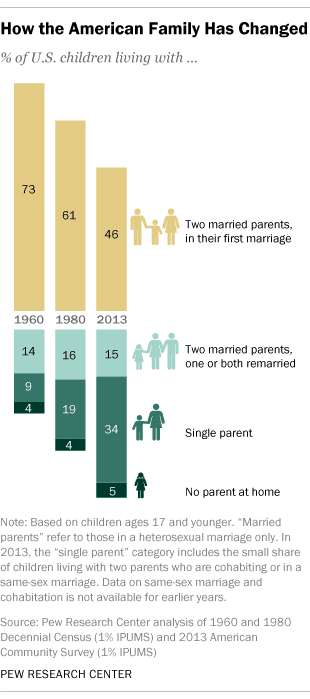
According to the Pew Research Center, fewer than half (46%) of American kids under 18 years of age are living in a home in 2018 with two married heterosexual parents in their first marriage – what is quaintly called a traditional family household. This is a huge change from 1960, when 73% of children fit this description, and 1980 when 61% did. At less than 50% today, it’s certainly a dwindling tradition.

One of the most enormous shifts in family structure is this one: 34% of American children today are living with an unmarried parent—up from just 9% in 1960, and 19% in 1980. In most cases, these unmarried parents are single, without a live-in partner of any kind to help raise and educate the children.

When I wrote Freemasons For Dummies in 2004, there was still a reasonable chance that enough grandfathers had been Freemasons in sufficient numbers that their grandchildren had at least encountered the fraternity in their lives. But that percentage has done nothing but drop since then.

Fewer children today have full-time fathers than ever before in recorded history, and even fewer of them have a grandfather to pass along older traditions like Freemasonry and numerous other important values.

(Interestingly, 5% of children are not living with either parent at all. In most of these cases, they are living with a grandparent—a phenomenon that has become much more prevalent since the recent economic recession.)
When you take into consideration all of this stew of statistics, it’s clear that Freemasonry as a subject for observation by children has a pretty paltry chance of being passed along to the current and future generations by many fathers, grandfathers, siblings, uncles or other influential men in their lives.
In other words, there’s no statistically significant reason why Sadie Dingfelder would have encountered Freemasons in her family. She doesn’t mention any sort of family connection to the fraternity, so the only way she knows anything at all about us is from what she picked up by cultural references she has encountered as a teenager and adult. Like going to the Memorial, poking around on the Internet, or catching a rerun on A&E or the History Channel. I suspect she may not have a single family member, friend or acquaintance who is a Mason, or was in recent memory.
Mull that over. And if she has children of her own today, what chance will they have as adults to inherit any sort of collective, cultural knowledge of Masonry in another 20 years?

Note her comments about Masonry being from a “less-woke era” (a colossally imbecilic adjective if ever there was one) and her pronouncement that our “fraught racial history and continued exclusion of women have also contributed to their diminishing relevance.” Whether you believe that or not, that is one narrative being circulated about us today in this hyper-heightened period of describing every single subject on the face of the Earth in terms of gender, race, offense, privilege  and oppression. Young people are being taught a dramatically different (and arguably damaging) version of Western and American history now than older generations, and the values, traditions and institutions of the Founders and prior important historical figures are being derided or ignored altogether. The images of George Washington and Ben Franklin as Freemasons don’t carry the sort of influence and impact they had even 20 years ago – some today would even argue that they are a negative.  And let’s not even venture into the demographics regarding religious beliefs among Americans in 2018, or how religious Americans are almost uniformly portrayed in a negative light by the pop culture.

None of this is an indictment of anyone, because there’s no single villain we can isolate and counter, argue with, or shoot out behind the barn. These are simply the current circumstances we find ourselves struggling in. That’s what we’re facing going forward as we try to craft messages for the profane world, design our museums, and sit for interviews with the press. Once again, the culture has shifted under our feet, and this time, we find ourselves potentially tap-dancing on a minefield.
As bleak as all of this may seem, at its core, Freemasonry is and will remain important and relevant and needed as time marches on, but it’s up to each of us to do our part to ensure its future by not hiding what’s left of our light under a bushel and permitting ourselves to be ignored to death. Remember that even Sadie recognizes this, and concluded her essay with this thought: “Perhaps a lot of this is best left in the past, but it seems to me — a person who spends way too much time alone, in front of a computer — that there’s something here worth bringing into the future.”
 

There is indeed.

This article was reblogged from: https://freemasonsfordummies.blogspot.com/2018/11/freemasonry-in-age-of-woke.html?m=1