A Pilgrim’s Way

I do not look for holy saints to guide me on my way,
Or male and female devilkins to lead my feet astray.
If these are added, I rejoice—if not, I shall not mind,
So long as I have leave and choice to meet my fellow-kind.
For as we come and as we go (and deadly-soon go we!)
The people, Lord, Thy people, are good enough for me!

Thus I will honour pious men whose virtue shines so bright
(Though none are more amazed than I when I by chance do right),
And I will pity foolish men for woe their sins have bred
(Though ninety-nine per cent. of mine I brought on my own head).
And, Amorite or Eremite, or General Averagee,
The people, Lord, Thy people, are good enough for me!

And when they bore me overmuch, I will not shake mine ears,
Recalling many thousand such whom I have bored to tears.
And when they labour to impress, I will not doubt nor scoff;
Since I myself have done no less and—sometimes pulled it off.
Yea, as we are and we are not, and we pretend to be,
The people, Lord, Thy people, are good enough for me!

And when they work me random wrong, as oftentimes hath been,
I will not cherish hate too long (my hands are none too clean).
And when they do me random good I will not feign surprise.
No more than those whom I have cheered with wayside charities.
But, as we give and as we take—whate’er our takings be—
The people, Lord, Thy people, are good enough for me!

But when I meet with frantic folk who sinfully declare
There is no pardon for their sin, the same I will not spare
Till I have proved that Heaven and Hell which in our hearts we have
Show nothing irredeemable on either side of the grave.
For as we live and as we die—if utter Death there be—
The people, Lord, Thy people, are good enough for me!

Deliver me from every pride—the Middle, High, and Low—
That bars me from a brother’s side, whatever pride he show.
And purge me from all heresies of thought and speech and pen
That bid me judge him otherwise than I am judged. Amen!
That I may sing of Crowd or King or road-borne company,
That I may labour in my day, vocation and degree,
To prove the same in deed and name, and hold unshakenly
(Where’er I go, whate’er I know, whoe’er my neighbor be)
This single faith in Life and Death and to Eternity:
“The people, Lord, Thy people, are good enough for me!”

By Brother Rudyard Kipling

The Spirit of The Laws

In 1748, our Brother, Charles-Louis de Secondat, Baron de La Brède et de Montesquieu, known to many as simply, “Montesquieu,” anonymously published De l’esprit des lois or, The Spirit of the Laws. It was published anonymously because any work Montesquieu authored was automatically subject to censorship.  Within three years, it had been translated into every language in Europe and, perhaps unsurprisingly, governments in Europe began to ban it.  Even the Catholic Church added the text to its Index Librorum Prohibitorum or, “List of Prohibited Books.”  What concepts were so dangerous that governments would seek to ban its being read?  A new form of constitutional government which expanded on ideas from another Brother, John Locke.

In the book, Montesquieu reframes civil and criminal law, placing personal security at the center of this more-robust legal system.  He argues for an individual’s right to the presumption of innocence, a fair trial, and for a proportional punishment for offences.  Further, and I believe critically, he builds on Locke’s work by stating that not only should the executive and legislative powers be held separately, but also the power held by the court.  America’s Founding Fathers were heavily influenced by the work and obviously incorporated the system into the nation’s highest law.  James Madison, who may have been a Mason, took Montesquieu’s concept still further, by asserting that each branch of government should have a means of “checking” the others.  These are now principles by which many successful governments operate.

Why do I bring this up?  Election time is upon us!  Not only will people across this great country be returning to the polls, but we, too, will soon be electing our Trustees, Temple Board, and lodge officers.  If you’re like me, and you have been watching the news for the last several months with uneasy feelings – or an inability to subdue your passions – take heart.  Know that our system of governance works best when people participate.  Try not to focus on the many ways you may disagree; pay attention to the things on which you agree.  Just think, we may never have known the benefits of a fair trial, the presumption of innocence, or a three-branch system with checks and balances, had not many individuals contributed.

The Wages of a Mason

What are the wages of a Speculative Mason?  Are there any?  The Fellow Craft Degree is the first time we hear about the wages of an Operative Mason, but we don’t really hear about the wages of a Speculative Mason.  So, what could they be?  For this, I believe we can look at the wages of our ancient Brethren.  In their day, the wages paid an operative Mason at the building of King Solomon’s Temple were among the more valuable commodities of the day.  Valuable, because these were staples in the diet of all those who lived in the Holy Land and have also been used, not coincidentally, in consecrations.  They ensured the perpetuity of life, society, the kingdom, as well as an individual’s soul.  Sharing a portion with those you care for was a duty, as was gifting them to those in need.  I see a parallel in the modern world in another, increasingly valuable commodity: time.  Time is precious, fleeting, and finite.  It, too, is a staple of our lives and the more of it we dedicate to something, the more impact we tend to have on it.  It is increasingly treated as sacred as well.

I submit, then, that the wages of a Speculative Mason is time.  Each hour spent coaching a candidate, mentoring a Brother, a DeMolay, or Job’s Daughter, or even planning and organizing an event for our lodge to enjoy, someone is receiving the wage of someone else’s time.  In thinking about this, I cannot help but recall the working tools of the Entered Apprentice, specifically, the twenty-four inch gauge.  Each of us is required to properly divide our time, and a portion of that time should be dedicated to “… the service to God and a distressed worthy Brother.”  When I was passed to the degree of Fellow Craft, my Coach told me to look for a place in the lodge to invest my time and energy and to try and make my dent on it.  I think the jury is still out and I still have quite a bit of time to invest in my Brothers, but it makes me wonder, how will you spend your wages?

Modern Politics, Masonry, and the Morgan Affair

Perhaps you recall the old quote, “Those who do not learn history are doomed to repeat it.”  This remark is actually paraphrased from the original quote, attributed to George Santayana, who said, “Those who cannot remember the past are condemned to repeat it.”  I think it is relevant this month, as it marks the anniversary of a particularly dark period of Masonic history in America.

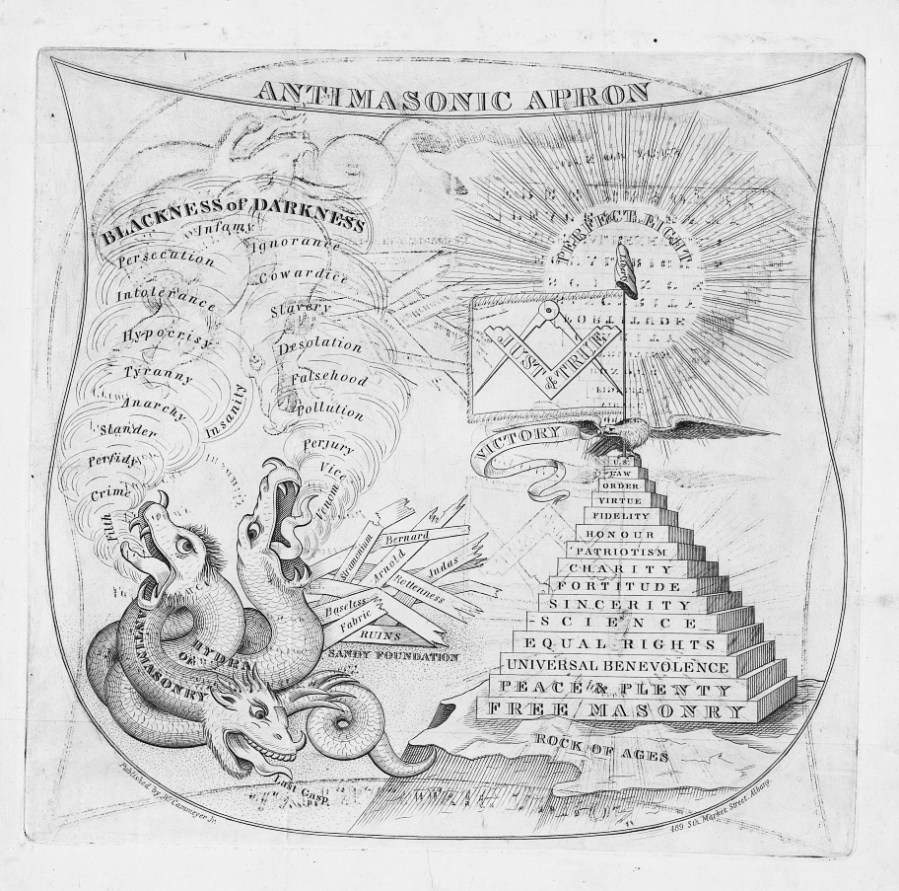
On September 12, 1826, William Morgan, who had published a supposed exposé of Masonic secrets, was taken from the jail in Canandaigua, New York, kidnapped, and possibly later murdered. The supposed perpetrators forgot their Charge as Entered Apprentice Masons.  This was the trigger for the notorious “Morgan Affair,” the further instigation of the Antimasonic movement, and the creation of the Antimasonic Party in the United States from the 1820s through the 1840s.  Interestingly, and among other things, it led to lodge business being only conducted in a Lodge of Master Masons, which was only changed in California within the last decade.

I note this, not because I believe any of you are capable of repeating such horrible acts but, because this can be a tough time of year; kids are reluctantly going back to school, more demands are being made of time and money – this alone can be very stressful!  As we inch closer to Election Day, too, it is likely you will be met with opinions which differ, perhaps greatly, from your own.  Your patience will be tested.  Subdue those passions, Brothers, and recall that …” you are charged to practice the domestic and public virtues.  Let Temperance chasten, Fortitude support, and Prudence direct you, and let Justice be the guide of all your actions.”  Your behavior determines how our fraternity is perceived.