The Chisel

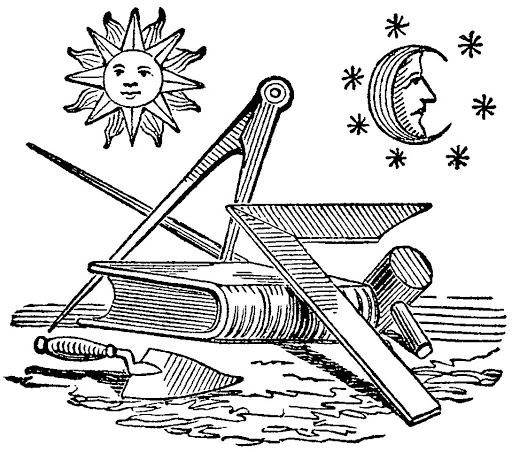
Have you ever wondered why our working tools exclude some common and necessary tools of the operative trade?  I have.  The one which springs to mind the most readily is the humble chisel.  In the first degree, we learn of the importance of the twenty-four-inch gauge and the common gavel – tools which allow us to measure the work in front of us and provide a means of carrying out the task (if only partially).  How, though, are we to accomplish anything without the tool with which we chip away at the rough stone? 

Dated to at least 8,000 BCE, chisels have been found all over the world, as have the results of their use. The term, “chisel,” is believed to have evolved from the French word, “ciseau,” meaning “to cut,” which itself may have come from the Latin word, “cisellum,” meaning the same.  In operative masonry, the chisel is typically a small, handheld tool of steel or iron and is used to mark or remove unnecessary portions of the stone, leaving only what is intended to be kept behind.  This, of course, is an alternative to simply hitting the stone with the gavel, resulting in a less controlled outcome.  In the absence of the chisel, the symbolism could be confusing.  To be clear, the chisel is part of the working tools in other jurisdictions, most notably in the UK.  But why not here?  In 1832, a meeting – now known as, “The Baltimore Convention” – was held in response to rising anti-Masonic sentiment caused by the notorious 1826, “Morgan Affair.”  Among the many items changed at this convention was the working tools and specifically the exclusion of the chisel.  It is unclear why exactly why these tools were dropped from ritual but, we can at least understand their original, speculative symbolism.  The chisel, “points out to us the advantages of education, by which means alone we are rendered fit members of regularly organized society.” Which make sense, if we put it in the context of the other tools identified in the Entered Apprentice degree.
The Quadrant

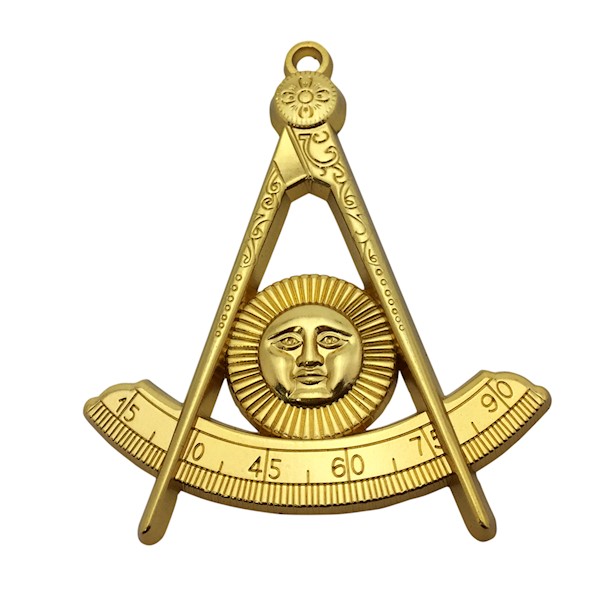
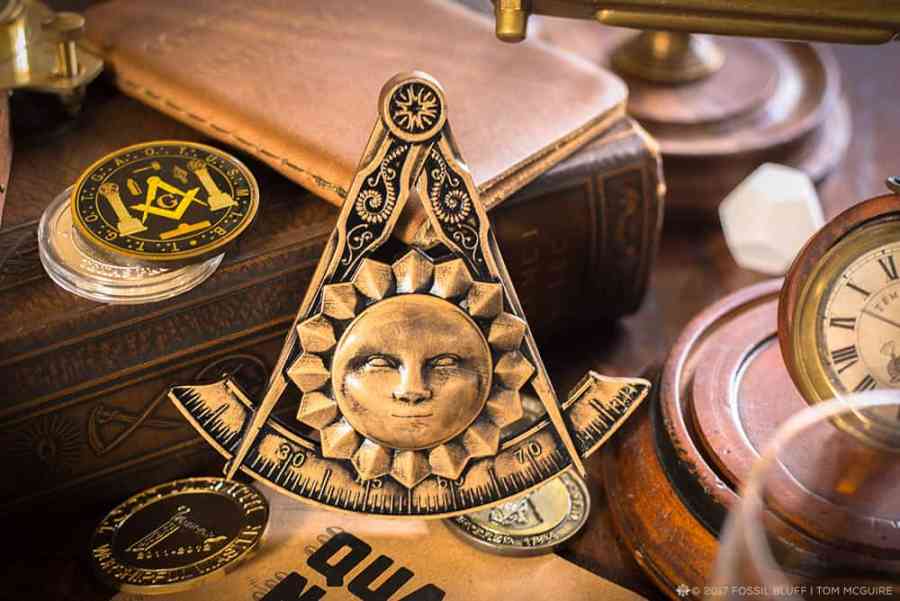
An often seen and seldom explained tool in Freemasonry, the quadrant (or protractor) is, in our jurisdiction, used in two very specific ways.  The first, and most common configuration is its combination with the compass (in the place of the square) to represent the office of Past Master.  The second is when it is combined with the symbol of our fraternity, the square and compass, to form the jewel of the Grand Master.  In other jurisdictions, this symbol represents the office of Past Master.  Regardless of the office it represents, the tool itself appears to have the same meaning. 

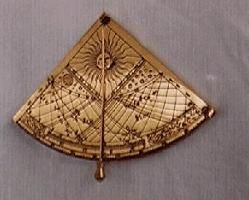
The quadrant was apparently proposed by mathematician, astronomer, natural philosopher, geographer, and astrologer, Ptolemy (c. 100 AD – c. 170 AD), as a replacement for the astrolabe. In his mathematical and astronomical treatise, Almagest, Ptolemy describes a “plinth” which could measure the altitude of the noon sun by projecting the shadow of a peg on a graduated arc of 90 degrees. Although his device was much larger and included several moving parts, it was the precursor for the tool we know today.

In speculative Freemasonry, the quadrant shows the angle at which the compasses are opened.  This measure is always 60˚, as this is the angle of an equilateral triangle, which is itself a symbol of balance.  The quadrant measures due boundaries (the circle drawn by the compass) and it serves as a reminder for the man that it was or is their responsibility to ensure that the Masons under his jurisdiction make proper use of their own compasses.  As suggested by Ptolemy, when paired with the compass, the quadrant can be used as a sextant (a navigating tool used in measuring altitude).  Imbued with this meaning, it symbolizes that the holder has navigated the course of his Lodge (as Master or Grand Master) and is qualified to assist or advise his successors, should the need arise.

The Lewis

Among the many tools of operative masonry still in use today is the humble lewis.  It is a rather ingenious device employed by operative Masons to raise heavy blocks of dressed stone into place.  It consists of three, typically metal (these days) parts: two wedge-shaped side pieces, and a straight center piece, that fit together (tenon). A dovetailed recess (mortise) is cut into the top of the stone block.  The two outer pieces are inserted first and then spread by the insertion of the centerpiece.  The three parts are then bolted together, a metal ring or shackle is attached, and the block is hoisted by hook, rope and pulley.

By these means the block is gripped securely.  Once set in its place in the structure, the lewis is removed, leaving the upper surface smooth with no clamp or chains on the outside to interfere with the laying of the next course.  In the uppermost course, a carved stone matching the indenture is inserted.  The tool is believed to have existed since at least the Roman era, with stones with the mortised cavity for the insertion of a lewis having been found in parts of Hadrian’s Wall, circa 121-127 C.E.

According to the Perseus Digital Library at Tufts University, the term “lewis,” may come from the Latin, “levo,” “levoavi,” or “levatum,” meaning to levitate or lift.  Although sources like the Oxford English Dictionary indicates this may not be true, stating the origin of the word as “obscure,” and potentially derived from a personal name.  However, what is clear is that the Romans called the hole in the stone itself a, “lewis hole.”

In speculative Masonry, the term “Lewis” is used to describe a Freemason’s son, who has not yet been initiated.

Logic

In a previous article on this topic, we introduced (or reintroduced) you to common logical fallacies. Those most frequently committed by people who may not even realize they are doing it.  They are expressions of flaws in the way we think about a subject.  We did not, however, talk about what logic is… 

Logic is the scientific study of “valid rule of inference.”  That is, the way we articulate relationships between propositions which lead to the acceptance of one, based on another accepted proposition or propositions.  Here is an example of formal logic:

Premise:All spiders have eight legs.  Black Widows are a type of spider.
Conclusion:Black Widows have eight legs.

The aim of logic is to secure clearness, consistency, and validity of reason – it is thinking about how to think.  We use logic every day whether we realize it or not.  If you’ve ever troubleshooted an engine that won’t turn over, a computer that won’t turn on, dough that won’t rise, or any other similar issue, you’re using logic.  Logic makes use of all of the senses in pursuit of validating propositions but combines knowledge of the other liberal arts and sciences to suss things out.Logic is important to Masons because it furthers the pursuit of one of our most important principles: truth (knowledge) and contributes to removing flaws in one’s own character.  It is through inquiry, induction, and deduction that we arrive at conclusions which separate fact from fiction, right from wrong, rationality from irrationality, being emotional from being cerebral.  True mastery of logic means freedom from anger, envy, and jealousy.  Of course, this is easier said than done.  It is one of the many reasons the journey in Masonry is lifelong.

Grammar

Grammar is far too important to dedicate only one month of the year to the topic.  As such, this month we will spend a little more time familiarizing ourselves with the subject… 

As noted in the March article, Masons concern themselves with the study of grammar because it, “assists us in conveying ideas and [to bring about] consensus, not division.  It is “[…] the skill of knowing language.  Grammar is the “who, what, when, where, and how” of understanding and knowledge.”  It is a set of rules for how we engage in speech and writing.

Grammar itself can be broken down into various frameworks, through which we arrive at specific scientific theories in the realm of theoretical linguistics.  One such example, called “functional grammar,” is an approach in which the linguistic processes and structures of language are analyzed.  The theories supporting this area propose that since language, at its core, is a tool.  Those who understand how best to use the tool are the most effective in conveying their thoughts and desires – eventually architecting effective rhetoric which persuades the listener.

This scientific approach often utilizes a “parsing,” or “derivation tree,” which represents the syntactic structure of a string of text which is free of any context (example below).  Very similar to approaches used in arithmetic (example below) and computer programming, in which the abstract structure of source code is represented.  These trees can be used both to gauge the fluency of language as well as ensure one is appropriately using the language.  Because parsing trees are used to help determine whether the “rules” are being appropriately applied, we can use them for a variety of purposes, including understanding and solving mathematical expressions.  Above is one such example (https://runestone.academy, 2020).

Arithmetic

Arithmetic is probably the least appreciated of the seven liberal arts and sciences.  But what is it, and why is it important to Masons?  Arithmetic is the study of numbers.  More particularly, the operations performed on them: adding, subtracting, multiplying and dividing.  It is the beginning of number theory – a branch of pure mathematics focused on the study of integers (natural numbers) and integer-value functions.  If that sounds a little elementary to you, you’re right.  Traditionally, we are exposed to arithmetic at a very early age.  We typically begin to learn these mathematical concepts at home before a more formal exposure in elementary school. 

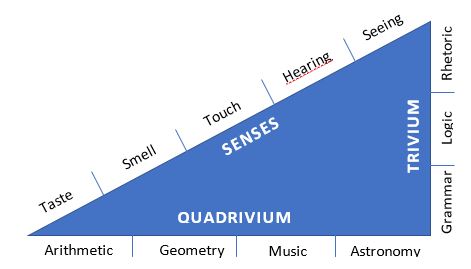
Arithmetic is where logical analysis and problem-solving starts. That is why it is a foundational element of the educational model today.  It’s so critical that throughout history, humans have created tools to help us understand and perform arithmetic functions.  One of the earliest examples, the Sumerian abacus, has been dated between 2700 and 2300 B.C.  While the elements of a “basic” or “well-rounded” education have varied widely throughout history, the “quadrivium,” or the “four scientific arts” (music, arithmetic, geometry, and astronomy) have been included since the days of Ancient Greece. In addition to the instructive aspect of arithmetic in logic and problem-solving, it has clear practical applications.  Arithmetic allows one to make reasonable assumptions, even without an abacus.  For example, in estimating the amount of money in your accounts, comparing the amount of time one project will take versus another, or even looking at a clock and telling time.  As Masons, we are taught that Geometry is the most important of the liberal arts and sciences, because of what it can do for us and tell us.  It’s important to note, however, Geometry probably wouldn’t exist without its predecessor, arithmetic.

Squaring The Square – The 47th Problem of Euclid

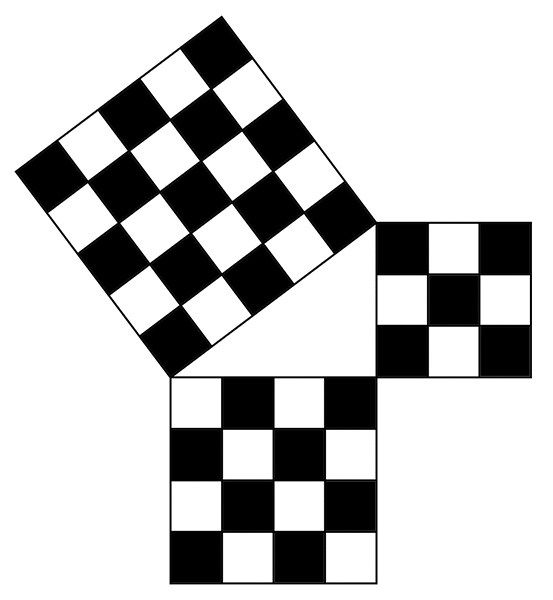
The 47th Problem of Euclid or the Pythagorean Theorem is often represented in Freemasonry by a symbol comprised of three squares, linked together to reveal a right triangle at their center. This somewhat mysterious symbol often puzzles the uninitiated and young Masons alike. The symbol, and the squares which make it up, are part of a mathematical ratio: 3:4:5. Why is it expressed this way? In any right triangle, the sum of the squares of the two sides is equal to the square of the hypotenuse.

So: 3² = 9; 4² = 16; 9 + 16 = 25; √25 = 5, thus: 3:4:5. 

From a practical, or operative perspective, the theorem is about laying a square and architecturally sound foundation upon which to erect a building.  Skilled builders would use this formula, as well as their knowledge of Astronomy (specifically, Polaris, the North Star – believed in ancient times to hold a fixed position in the sky) to layout a perfect North-South line.  Once this line was made, they could use the square to draw the East-West line, and from there could use the theorem to establish a perfect 90° angle at the Northeast corner, where they would place the first cornerstone.

From a speculative perspective, we must remember that the square is an emblem of truth and morality. If the 47th Problem of Euclid is the means by which we can always operatively find a square by thinking rationally and reasonably, so too, can we find it speculatively in the same manner.  Need more convincing that rational thought and expression can lead to reminders of our spiritual journey in Masonry?  Let’s think about the first four numbers: 1, 2, 3, 4.  Now, we square them:

1² = 1; 2² = 4; 3² = 9; 4² = 16.  So we have: 1, 4, 9, 16. 

When we subtract each square from the next: 4-1 = 3; 9-4 = 5; 16-9 = 7; or 3, 5, 7. 

Look familiar?  These are the steps in Masonry and also reflect the number of Brethren required to open a Lodge in each degree: Master Mason = 3; Fellow Craft = 5; and Entered Apprentice = 7.

A Certain Point Within a Circle

Full transparency: I have written and rewritten this article five times.  There’s so much happening around us.  So much pain, frustration, anger, disappointment, and sadness.  So many things are being called into question, it is sometimes hard to make sense of it all.  As a Mason, I have found it hard in recent weeks to remember my working tools; to circumscribe my desires and keep my passions within due bounds.  Masonry, though, is a practice.  Which means you sometimes fall short, not because you weren’t trying but because sometimes it’s too much and you’re a flawed human being. 

Masonry teaches us that we have a responsibility to help make the world a better place while being devoted to family, faith, country, and fraternity.  We value and promote ethics, personal growth, tolerance, education, diversity, philanthropy, family, and community.  So, as we drive through town with shouting protesters and counter protesters, see historic statues tumble to the ground, or listen to politicians attacking one another’s beliefs, platform, and party, we need to be mindful.  Mindfulness is one of a Mason’s most powerful tools.  It allows us to calmly acknowledge an accept another person or group of people’s feelings, thoughts, as a valid experience for them.  We should seek to understand where our feelings come from and be honest with ourselves about them.  It takes effort.  It’s not easy. Nothing about Masonic philosophy says we must make other’s experiences our own but, we should be empathetic.  We should seek to find common ground – things that we share, rather than things which make us different – and a mutual respect.  We have to keep trying.  If only to model to the rest of society that there’s a better way. 

Brotherly Love

“By the exercise of Brotherly Love, we are taught to regard the whole human race as one family – the high, the low, the rich, the poor – who, as created by one Almighty Parent, and inhabiting the same planet, should aid, support, and protect one another. On this principle, Masonry unites men of every country, sect, and opinion, and promotes true friendship among those who might otherwise have remained at a perpetual distance.”

This is what we all hear in lodge and what we are encouraged to practice.  So, we embrace our Brothers in lodge, after meals, and as we hastily make our way into or out of meetings.  Some may loan or giveaway clothes, tools, furniture, money, or simply our talent, to those in need.  The best of us reach out to our friends when we haven’t heard from them in a while, seen them in lodge, or some we will even stop by the Brother’s house to see how they are.  However small, these are all good examples of the tenet being put into action within our Fraternity.

However, they are… We are… I am… Guilty of focusing too much on what this means among Brothers.  We allow culture, country, sect, opinion, and any one of a dozen other factors, to distract us from what I am coming to see as the more important part of the statement: “to regard the whole human race as one family.”  We could all stand to remember that when our life and choices are measured, it will be our acts of kindness toward those we don’t know which will carry the most weight.