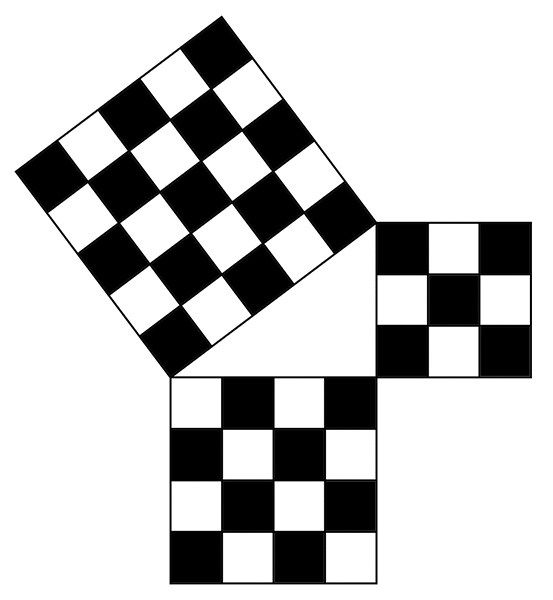
The 47th Problem of Euclid or the Pythagorean Theorem is often represented in Freemasonry by a symbol comprised of three squares, linked together to reveal a right triangle at their center. This somewhat mysterious symbol often puzzles the uninitiated and young Masons alike. The symbol, and the squares which make it up, are part of a mathematical ratio: 3:4:5. Why is it expressed this way? In any right triangle, the sum of the squares of the two sides is equal to the square of the hypotenuse.
So: 3² = 9; 4² = 16; 9 + 16 = 25; √25 = 5, thus: 3:4:5.
From a practical, or operative perspective, the theorem is about laying a square and architecturally sound foundation upon which to erect a building. Skilled builders would use this formula, as well as their knowledge of Astronomy (specifically, Polaris, the North Star – believed in ancient times to hold a fixed position in the sky) to layout a perfect North-South line. Once this line was made, they could use the square to draw the East-West line, and from there could use the theorem to establish a perfect 90° angle at the Northeast corner, where they would place the first cornerstone.
From a speculative perspective, we must remember that the square is an emblem of truth and morality. If the 47th Problem of Euclid is the means by which we can always operatively find a square by thinking rationally and reasonably, so too, can we find it speculatively in the same manner. Need more convincing that rational thought and expression can lead to reminders of our spiritual journey in Masonry? Let’s think about the first four numbers: 1, 2, 3, 4. Now, we square them:
1² = 1; 2² = 4; 3² = 9; 4² = 16. So we have: 1, 4, 9, 16.
When we subtract each square from the next: 4-1 = 3; 9-4 = 5; 16-9 = 7; or 3, 5, 7.
Look familiar? These are the steps in Masonry and also reflect the number of Brethren required to open a Lodge in each degree: Master Mason = 3; Fellow Craft = 5; and Entered Apprentice = 7.
 Thoughts on Life and Freemasonry