
In his 360 B.C. dialog, Timaeus, Plato wrote about the concept of what is now referred to as Platonic Solids (later named for Plato). These were likely discovered well before Plato, despite his getting all of the credit. Also known as regular solids, or regular polyhedra, they are convex polyhedra with equivalent faces composed of congruent convex regular polygons. There are exactly five: the cube, dodecahedron, icosahedron, octahedron, and tetrahedron. Some of the more geeky Brethren would probably recognize many of these shapes in dice commonly used in role-playing board games, like Dungeons and Dragons, or puzzles, like the Rubik’s Cube (which comes in each of these shapes, consequently).
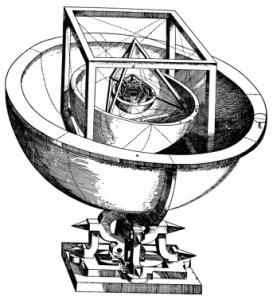
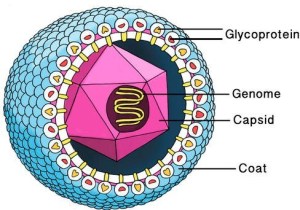
The shapes are important, not only for helping decide the fate of one’s High Elf Fighter but, were anciently believed to have had a fundamental role in the cosmos. In 1596, Johannes Kepler published the book, Mysterium Cosmographicum, in which he theorized that positions of the known planets and their respective orbits corresponded to the Platonic Solids inscribed within one another (see image 1). That theory has been disproven, but the shapes still fascinate mathematicians, philosophers, and architects alike. Interestingly, the further scholars have gotten from theories about these shapes, the more often they saw them. For example, the tetrahedron, cube, and octahedron, all occur naturally in crystal structures. Certain chemical compounds include discrete icosahedra within their crystal structures. Many viruses have the shape of regular icosahedron and it has been discovered that this special shape allows the virus replicate more easily and save space in its genome (see image 2). Even in modern meteorology and climatology, global numerical models now increasingly employ geodesic grids based on an icosahedron, rather than the more commonly used longitude/latitude grid, because of the increased resolution these models provide.
 Thoughts on Life and Freemasonry